LAMBDA = 0.005       # Micro-scale length scale
PHI = 0.0           # Micro-scale phase offset
A_H0 = 0.6          # Amplitude of smooth field H0(X) = A_H0 * sin(2*pi*X)
A_H1 = 0.05        # Amplitude of microscale field H1
F_AMP = 1.0         # Amplitude of source term
L = 1.0             # Macroscale domain length
N_MACRO = 128        # Macro mesh elements (coarse)
N_FINE = 2000       # Fine mesh elements to resolve the microscale features in the deterministic model
N_MICRO = 64        # Micro mesh elements
MAX_HMM_ITER = 50   # Maximum HMM coupling iterations
HMM_TOL = 1e-6 # Convergence tolerance for HMM iterationHeterogeneous Multiscale Methods (HMM) Demonstration
1D elliptic PDE demonstration using FEniCS, implementing the HMM framework and comparing with a high resolution deterministic model and a smooth single scale model.
The governing equation has the form:
\[\frac{d}{dX} \left[ \Gamma \frac{dY}{dX} \right] = F\]
where \(\Gamma = g(H, Y, \frac{dY}{dX})\), \(F = f(H, Y, \frac{dY}{dX})\) are general functions of a field \(H\), the solution \(Y\), and the gradient \(\frac{dY}{dX}\).
Three scenarios:
- Smooth macroscale — Property field \(H = H_0(X)\) only (no fine-scale features), solved on a coarse mesh.
- Deterministic — Field \(H = H_0(X) + H_1(X, \lambda, \phi)\) now includes fine-scale features or noise, solved on a fine mesh.
- HMM coupled multiscale — Macro-scale solved with homogenised micro solutions providing effective \(\bar{\Gamma}\) and \(\bar{F}\).
Imports and Setup
Physical Parameters
Problem dimensions, mesh resolutions, and HMM settings.
In [4]:
Field Definitions
- \(H_0(X) = A_{H_0} \sin(2\pi X)\) — smooth macro
- \(H_1(x, \lambda, \phi) = A_{H_1} \sin(2\pi x / \lambda + \phi)\) — fine-scale perturbation
In [6]:
def H0_func(X):
    """Smooth macro field: H0(X) = A_H0 * sin(2*pi*X)"""
    return A_H0 * np.sin(2 * np.pi * X)


def H1_func(x, lam, phi):
    """Fine-scale field perturbation: H1(x, lambda, phi) = A_H1 * sin(2*pi*x/lambda + phi)"""
    return A_H1 * np.sin(2 * np.pi * x / lam + phi)
Constitutive Relations for diffusion and source terms: \(\Gamma(H, Y, dY/dX)\) and \(F(H, Y, dY/dX)\)
These are the functions used at both macro and micro scales. For this example, \(\Gamma\) is dependent on \(H\). We could make it fully nonlinear problem by adding \(Y\) and \(dY/dX\) dependence in both \(\Gamma\) and \(F\).
In [8]:
def Gamma_func(H, Y=None, dYdX=None):
    """
    Diffusion coefficient as a function of the field.
        Gamma(H, Y, dY/dX) = 1 + H
    """
    return 1.0 + H


def f_source_func(X, H=None, Y=None, dYdX=None):
    """
    Source term:
        f(X) = F_AMP * sin(3*pi*X)
    """
    return F_AMP * np.sin(3 * np.pi * X)
FEniCS Expressions
Custom classes for evaluating \(\Gamma\) and \(f\) at quadrature points.
In [10]:
class SmoothGamma(UserExpression):
    """Gamma using only H0: Gamma(H0(X)) = 1 + H0(X)"""
    def eval(self, values, x):
        H0 = H0_func(x[0])
        values[0] = Gamma_func(H0)

    def value_shape(self):
        return ()


class FullGamma(UserExpression):
    """Gamma using full H = H0 + H1: Gamma(H(X)) = 1 + H0(X) + H1(X, lambda, phi)"""
    def eval(self, values, x):
        H = H0_func(x[0]) + H1_func(x[0], LAMBDA, PHI)
        values[0] = Gamma_func(H)

    def value_shape(self):
        return ()


class SourceExpression(UserExpression):
    """Source term: f(X) = F_AMP * sin(3*pi*X)"""
    def eval(self, values, x):
        values[0] = f_source_func(x[0])

    def value_shape(self):
        return ()
Unified FEM Solver
A single solver function used for all scenarios — only the \(\Gamma\) expression and mesh resolution change.
In [12]:
def solve_fem(gamma_expr, n_elements, label="FEM"):
    """
    Solve the 1D elliptic BVP using FEM:

        d/dX [ Gamma * dY/dX ] = f   on [0, L]
        Y(0) = Y(L) = 0

    Same solver for all scenarios — only the Gamma expression and mesh change.
    """
    print(f"  {label}")

    # 1D Mesh with continuous Galerkin elements
    mesh = IntervalMesh(n_elements, 0.0, L)
    V = FunctionSpace(mesh, "CG", 1)

    def boundary(x, on_boundary):
        return on_boundary
    #Fixed dirichlet conditions on the boundaries
    bc = DirichletBC(V, Constant(0.0), boundary)

    u = TrialFunction(V)
    v = TestFunction(V)
    f = SourceExpression(degree=2)

    a_form = gamma_expr * dot(grad(u), grad(v)) * dx
    L_form = f * v * dx

    u_h = Function(V)
    solve(a_form == L_form, u_h, bc)

    coords = mesh.coordinates().flatten()
    idx = np.argsort(coords)
    coords = coords[idx]
    vals = u_h.compute_vertex_values(mesh)[idx]

    print(f"  Mesh elements: {n_elements}")
    print(f"  Solution range: [{vals.min():.6f}, {vals.max():.6f}]")
    print()

    return coords, vals
Scenario 1: Smooth Macroscale Problem
Field \(H = H_0(X)\) only (no micro features). Solved on a coarse macro mesh.
In [14]:
smooth_data = solve_fem(
    SmoothGamma(degree=2), N_MACRO,
    label="Scenario 1: Smooth macro Gamma(H0) on coarse mesh")
In [15]:
# --- Plot: Smooth macroscale solution ---
coords_s, vals_s = smooth_data

fig, ax = plt.subplots(figsize=(6, 4))
ax.plot(coords_s, vals_s, 'r-', linewidth=2, label=r"Smooth macro $Y(X)$ with $\Gamma(H_0)$")
ax.set_xlabel('X')
ax.set_ylabel('Y(X)')
ax.set_title('Scenario 1: Smooth Macroscale Solution')
ax.legend()
ax.grid(True, alpha=0.3)
plt.tight_layout()
plt.show()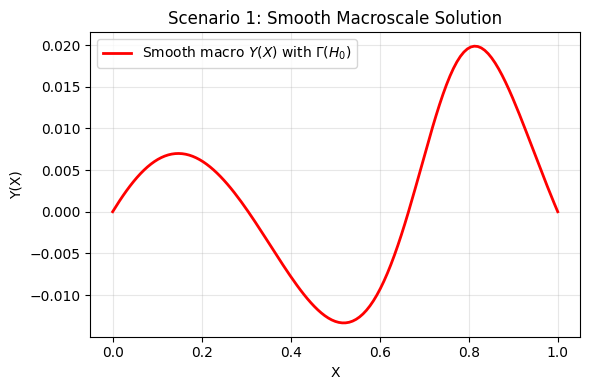
Scenario 2: Deterministic Problem (High resolution)
Property field \(H = H_0(X) + H_1(X, \lambda, \phi)\) with fine-scale texture. Solved on a fine mesh that resolves all oscillations.
In [17]:
fine_data = solve_fem(
    FullGamma(degree=2), N_FINE,
    label="Scenario 2: Fine-resolved FEM with Gamma(H0 + H1)")
In [18]:
# --- Plot: Deterministic vs Smooth ---
coords_s, vals_s = smooth_data
coords_f, vals_f = fine_data

fig, ax = plt.subplots(figsize=(8, 4))
ax.plot(coords_s, vals_s, 'r--', linewidth=2,
        label=r'Smooth macro ($\Gamma_0$)', zorder=2)
ax.plot(coords_f, vals_f, 'b-', alpha=0.85, linewidth=1.5,
        label='Deterministic (fine-resolved)', zorder=1)
ax.set_xlabel('X')
ax.set_ylabel('Y(X)')
ax.set_title('Scenario 2: Deterministic vs Smooth Solution')
ax.legend()
ax.grid(True, alpha=0.3)
plt.tight_layout()
plt.show()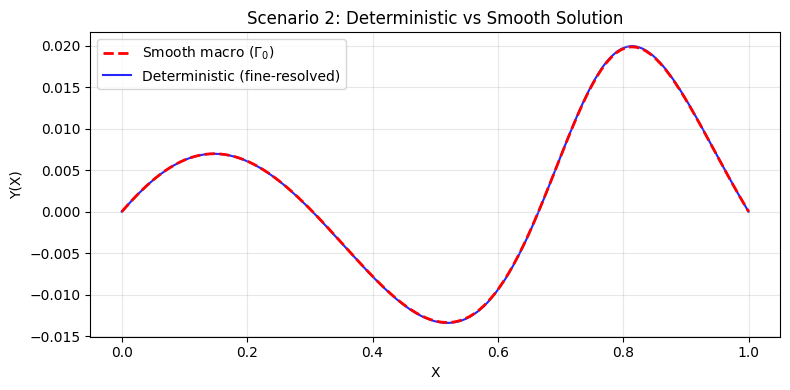
Scenario 3: HMM
Micro/Cell Problem Solver
Solves the micro problem on a representative microscale cell \([-\lambda/2, \lambda/2]\) for each macro node.
Boundary conditions: - \(y(\lambda/2) = y(-\lambda/2) + \lambda \, dY/dX\) (periodic offset) - \(\Gamma \, dy/dx(-\lambda/2) = \Gamma \, dy/dx(\lambda/2)\) (periodic flux) - \(y(0) = Y\) (centre constraint)
Returns homogenised \(\bar{\Gamma}\), \(\bar{f}\), and \(\bar{H}\) to the macro scale.
In [20]:
def solve_micro_cell_problem(X_macro, Y_macro, dYdX_macro):
    """
    Solve the micro/cell problem on a representative cell.

    Domain: [-lambda/2, lambda/2]

    PDE:    d/dx [ gamma * dy/dx ] = f_micro

    Returns
    -------
    Gamma_bar : float
        Effective Gamma over the cell.
    f_bar : float
        Homogenised source term over the cell.
    H_bar : float
        Homogenised property field over the cell.
    micro_info : dict
        Min/max of y, gamma, f, and h from the micro solution.
    """
    half_lam = LAMBDA / 2.0
    micro_mesh = IntervalMesh(N_MICRO, -half_lam, half_lam)
    V_micro = FunctionSpace(micro_mesh, "CG", 1)

    # Field on the micro domain
    H0_val = H0_func(X_macro)

    class MicroPropertyField(UserExpression):
        """h(x) = H0(X_macro) + H1(x, lambda, phi)"""
        def eval(self, values, x):
            values[0] = H0_val + H1_func(x[0], LAMBDA, PHI)

        def value_shape(self):
            return ()

    h_expr = MicroPropertyField(degree=2)

    class MicroGamma(UserExpression):
        """gamma(x) = Gamma(h(x)) = 1 + h(x)"""
        def eval(self, values, x):
            h = H0_val + H1_func(x[0], LAMBDA, PHI)
            values[0] = Gamma_func(h)

        def value_shape(self):
            return ()

    gamma_micro = MicroGamma(degree=2)

    class MicroSource(UserExpression):
        """f_micro(x) = f(X_macro + x)"""
        def eval(self, values, x):
            values[0] = f_source_func(X_macro + x[0])

        def value_shape(self):
            return ()

    f_micro = MicroSource(degree=2)

    # Boundary conditions with the offset periodicity
    y_left = Y_macro - dYdX_macro * half_lam
    y_right = Y_macro + dYdX_macro * half_lam

    def left_boundary(x, on_boundary):
        return on_boundary and near(x[0], -half_lam)

    def right_boundary(x, on_boundary):
        return on_boundary and near(x[0], half_lam)

    bc_left = DirichletBC(V_micro, Constant(y_left), left_boundary)
    bc_right = DirichletBC(V_micro, Constant(y_right), right_boundary)
    bcs = [bc_left, bc_right]

    # Solve: d/dx [ gamma * dy/dx ] = f_micro
    w = TrialFunction(V_micro)
    v = TestFunction(V_micro)

    a_form = gamma_micro * dot(grad(w), grad(v)) * dx
    L_form = f_micro * v * dx

    y_h = Function(V_micro)
    solve(a_form == L_form, y_h, bcs)

    # --- Homogenisation ---
    gamma_projected = project(gamma_micro, V_micro)
    f_projected = project(f_micro, V_micro)
    h_projected = project(h_expr, V_micro)

    # Gamma_bar: harmonic mean
    inv_gamma = project(Constant(1.0) / gamma_projected, V_micro)
    avg_inv_gamma = assemble(inv_gamma * dx) / LAMBDA
    Gamma_bar = 1.0 / avg_inv_gamma

    # f_bar = (1/lambda) * integral f_micro dx
    f_bar = assemble(f_projected * dx) / LAMBDA

    # H_bar = (1/lambda) * integral h dx
    H_bar = assemble(h_projected * dx) / LAMBDA

    # --- Extract min/max from micro solution for plotting ---
    y_vals = y_h.compute_vertex_values(micro_mesh)
    gamma_vals = gamma_projected.compute_vertex_values(micro_mesh)
    f_vals = f_projected.compute_vertex_values(micro_mesh)
    h_vals = h_projected.compute_vertex_values(micro_mesh)

    micro_coords = micro_mesh.coordinates().flatten()
    micro_sort = np.argsort(micro_coords)
    micro_coords_sorted = micro_coords[micro_sort] + X_macro
    micro_y_sorted = y_vals[micro_sort]

    micro_info = {
        'y_min': y_vals.min(), 'y_max': y_vals.max(),
        'gamma_min': gamma_vals.min(), 'gamma_max': gamma_vals.max(),
        'f_min': f_vals.min(), 'f_max': f_vals.max(),
        'h_min': h_vals.min(), 'h_max': h_vals.max(),
        'micro_coords': micro_coords_sorted,
        'micro_y': micro_y_sorted,
    }

    return Gamma_bar, f_bar, H_bar, micro_info
HMM Coupled Multiscale Solver
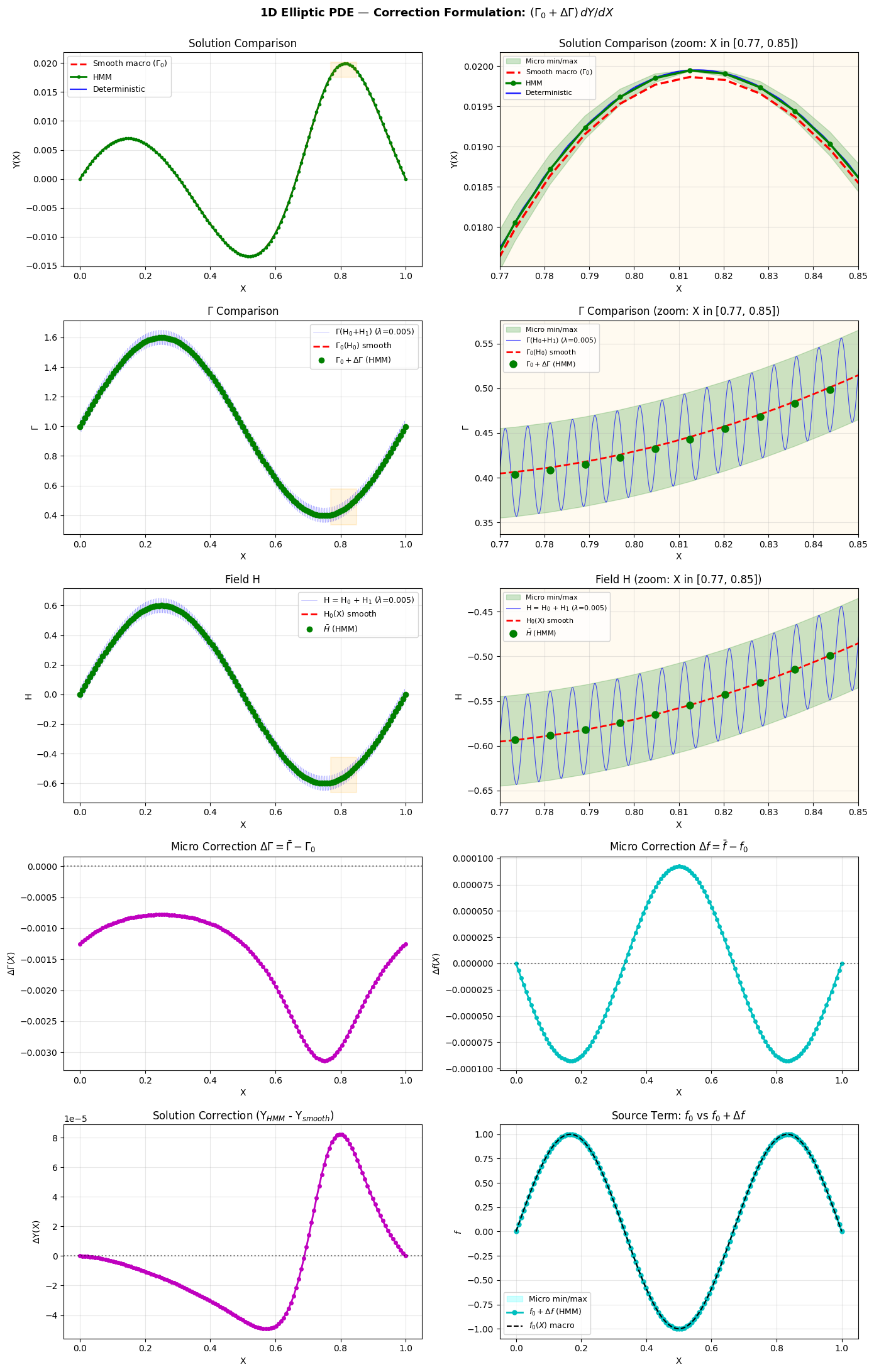
Iterative coupling between macro and micro scales using the correction formulation:
\[\frac{d}{dX} \left[ (\Gamma_0 + \Delta\Gamma) \frac{dY}{dX} \right] = (F_0 + \Delta F)\]
where \(\Gamma_0 = \Gamma(H_0)\) and \(F_0 = F(X)\) are the smooth baseline, and the corrections are:
\[\Delta\Gamma_i = \bar{\Gamma}_i - \Gamma_0(X_i), \qquad \Delta F_i = \bar{F}_i - F_0(X_i)\]
Algorithm: 1. Initial macro solve with smooth \(\Gamma_0\), \(f_0\) to get \(Y\), \(dY/dX\). 2. At every macro node, solve a micro cell problem → \(\bar{\Gamma}\), \(\bar{F}\). 3. Compute corrections: \(\Delta\Gamma = \bar{\Gamma} - \Gamma_0\), \(\Delta F = \bar{F} - F_0\). 4. Re-solve macro with \((\Gamma_0 + \Delta\Gamma)\) and \((F_0 + \Delta F)\). 5. Iterate until convergence.
In [22]:
def solve_hmm_multiscale():
    """
    HMM coupled multiscale solver using the correction formulation:

        d/dX [ (Gamma_0 + Delta_Gamma) dY/dX ] = (f_0 + Delta_f)

    Micro solves provide Gamma_bar and f_bar; the corrections are:
        Delta_Gamma = Gamma_bar - Gamma_0(X)
        Delta_f     = f_bar     - f_0(X)

    Returns HMM solution, initial smooth solution,
    correction, homogenised quantities, delta arrays, and micro info.
    """
    print("SCENARIO 3: HMM coupled multiscale")

    macro_mesh = IntervalMesh(N_MACRO, 0.0, L)
    V_macro = FunctionSpace(macro_mesh, "CG", 1)

    def boundary(x, on_boundary):
        return on_boundary

    bc = DirichletBC(V_macro, Constant(0.0), boundary)

    u_trial = TrialFunction(V_macro)
    v_test = TestFunction(V_macro)

    # --- Smooth baseline expressions (constant throughout) ---
    gamma_smooth = SmoothGamma(degree=2)
    f_macro_expr = SourceExpression(degree=2)

    # --- Step 1: Initial macro solve with smooth Gamma(H0) ---
    print("  Step 1: Initial macro solve (smooth Gamma_0, f_0)...")

    a_form = gamma_smooth * dot(grad(u_trial), grad(v_test)) * dx
    L_form = f_macro_expr * v_test * dx

    u_macro = Function(V_macro)
    solve(a_form == L_form, u_macro, bc)

    # Store the initial smooth solution for computing correction later
    u_smooth_initial = Function(V_macro)
    u_smooth_initial.vector()[:] = u_macro.vector()[:]

    # Get sorted macro node coordinates and mapping
    macro_coords = macro_mesh.coordinates().flatten()
    sort_idx = np.argsort(macro_coords)
    macro_coords_sorted = macro_coords[sort_idx]
    n_nodes = len(macro_coords_sorted)
    v2d = vertex_to_dof_map(V_macro)

    # Evaluate smooth-scale quantities at macro nodes (fixed reference)
    Gamma0_at_nodes = np.array([Gamma_func(H0_func(x)) for x in macro_coords_sorted])
    f0_at_nodes = np.array([f_source_func(x) for x in macro_coords_sorted])

    # --- Iteration loop ---
    converged_iter = MAX_HMM_ITER
    micro_info_all = None
    Delta_Gamma_nodal = None
    Delta_f_nodal = None

    for hmm_iter in range(MAX_HMM_ITER):
        print(f"\n  --- HMM Iteration {hmm_iter + 1} ---")
        print(f"  Step 2: Solving {n_nodes} micro cell problems...")

        Gamma_bar_nodal = np.zeros(n_nodes)
        f_bar_nodal = np.zeros(n_nodes)
        H_bar_nodal = np.zeros(n_nodes)
        micro_info_list = []

        for i, x_node in enumerate(macro_coords_sorted):
            Y_macro = u_macro(Point(x_node))

            # Compute macro gradient at this node via finite difference
            delta = 0.5 * (L / N_MACRO)
            x_left = max(0.0, x_node - delta)
            x_right = min(L, x_node + delta)
            dYdX_macro = (u_macro(Point(x_right)) - u_macro(Point(x_left))) / \
                         (x_right - x_left)

            Gamma_bar, f_bar, H_bar, micro_info = solve_micro_cell_problem(
                x_node, Y_macro, dYdX_macro)

            Gamma_bar_nodal[i] = Gamma_bar
            f_bar_nodal[i] = f_bar
            H_bar_nodal[i] = H_bar
            micro_info_list.append(micro_info)

            if i % 8 == 0 or i == n_nodes - 1:
                print(f"    Node {i:3d}/{n_nodes-1}: X={x_node:.4f}, "
                      f"Y={Y_macro:+.4f}, dY/dX={dYdX_macro:+.4f}, "
                      f"Gbar={Gamma_bar:.4f}, fbar={f_bar:+.4f}, "
                      f"Hbar={H_bar:+.4f}")

        micro_info_all = micro_info_list

        # --- Step 3: Compute corrections Delta_Gamma, Delta_f ---
        Delta_Gamma_nodal = Gamma_bar_nodal - Gamma0_at_nodes
        Delta_f_nodal = f_bar_nodal - f0_at_nodes

        print("  Step 3: Computing corrections from micro results...")
        print(f"    Delta_Gamma range: [{Delta_Gamma_nodal.min():+.6f}, "
              f"{Delta_Gamma_nodal.max():+.6f}]")
        print(f"    Delta_f     range: [{Delta_f_nodal.min():+.6f}, "
              f"{Delta_f_nodal.max():+.6f}]")

        # Assign corrections to FEniCS Functions
        Delta_Gamma_func = Function(V_macro)
        Delta_f_func = Function(V_macro)

        for i_sorted, i_orig in enumerate(sort_idx):
            dof_idx = v2d[i_orig]
            Delta_Gamma_func.vector()[dof_idx] = Delta_Gamma_nodal[i_sorted]
            Delta_f_func.vector()[dof_idx] = Delta_f_nodal[i_sorted]

        # --- Step 4: Re-solve macro with (Gamma_0 + Delta_Gamma), (f_0 + Delta_f) ---
        print("  Step 4: Macro re-solve with (Gamma_0 + Delta_Gamma) "
              "and (f_0 + Delta_f)...")

        a_form_eff = (gamma_smooth + Delta_Gamma_func) * \
                     dot(grad(u_trial), grad(v_test)) * dx
        L_form_eff = (f_macro_expr + Delta_f_func) * v_test * dx

        u_new = Function(V_macro)
        solve(a_form_eff == L_form_eff, u_new, bc)

        # --- Check convergence ---
        diff = u_new.vector()[:] - u_macro.vector()[:]
        residual = np.sqrt(np.sum(diff**2))
        u_norm = np.sqrt(np.sum(u_macro.vector()[:]**2))
        rel_change = residual / max(u_norm, 1e-14)

        print(f"  Convergence: ||dY|| = {residual:.2e}, "
              f"||dY||/||Y|| = {rel_change:.2e}")

        u_macro.vector()[:] = u_new.vector()[:]

        if rel_change < HMM_TOL:
            converged_iter = hmm_iter + 1
            print(f"  *** Converged after {converged_iter} iteration(s) ***")
            break
    else:
        converged_iter = MAX_HMM_ITER
        print(f"  *** Warning: did not converge in {MAX_HMM_ITER} iterations ***")

    print("\n  Step 5: Computing additive correction...")

    delta_u = Function(V_macro)
    delta_u.vector()[:] = u_macro.vector()[:] - u_smooth_initial.vector()[:]

    coords = macro_coords_sorted
    vals_hmm = u_macro.compute_vertex_values(macro_mesh)[sort_idx]
    vals_smooth = u_smooth_initial.compute_vertex_values(macro_mesh)[sort_idx]
    vals_correction = delta_u.compute_vertex_values(macro_mesh)[sort_idx]

    print(f"  Macro nodes: {n_nodes} (= {N_MACRO} elements + 1)")
    print(f"  Micro solves: {n_nodes} x {converged_iter} iterations = "
          f"{n_nodes * converged_iter} total")
    print(f"  HMM solution range: [{vals_hmm.min():.6f}, {vals_hmm.max():.6f}]")
    print(f"  Max additive correction: {np.max(np.abs(vals_correction)):.6f}")
    print()

    return (coords, vals_hmm, vals_smooth, vals_correction,
            macro_coords_sorted, Gamma_bar_nodal, f_bar_nodal, H_bar_nodal,
            micro_info_all, Delta_Gamma_nodal, Delta_f_nodal,
            Gamma0_at_nodes, f0_at_nodes)
Run HMM Coupled Multiscale Solver
In [24]:
hmm_data = solve_hmm_multiscale()In [25]:
# --- Plot: 10 selected microscale solutions ---
coords_h, vals_hmm, vals_smooth, vals_corr, x_nodes, \
    Gamma_bar, f_bar, H_bar, micro_info_all, \
    Delta_Gamma, Delta_f, Gamma0_nodes, f0_nodes = hmm_data

n_micros = len(micro_info_all)
# Select 10 evenly spaced micro problems to display
selected_indices = np.linspace(0, n_micros - 1, 4, dtype=int)

fig, axes = plt.subplots(2, 2, figsize=(6, 6), sharey=True)
fig.suptitle('Microscale Cell Solutions at 4 Selected Macro Nodes',
             fontsize=13, fontweight='bold')

for ax_idx, mi in enumerate(selected_indices):
    ax = axes.flat[ax_idx]
    info = micro_info_all[mi]
    mc = info['micro_coords']
    my = info['micro_y']
    X_node = x_nodes[mi]

    ax.plot(mc, my, 'g-', linewidth=1.5)
    ax.axhline(y=vals_hmm[mi], color='r', linestyle='--', alpha=0.6,
               linewidth=1, label="$Y_{macro}$" if ax_idx == 0 else None)
    ax.set_title(f'X = {X_node:.3f}', fontsize=9)
    ax.set_xlabel('x (global)', fontsize=7)
    ax.tick_params(labelsize=7)
    ax.grid(True, alpha=0.3)

axes[0, 0].set_ylabel('y(x)', fontsize=9)
axes[1, 0].set_ylabel('y(x)', fontsize=9)
axes[0, 0].legend(fontsize=7, loc='best')
plt.tight_layout()
plt.show()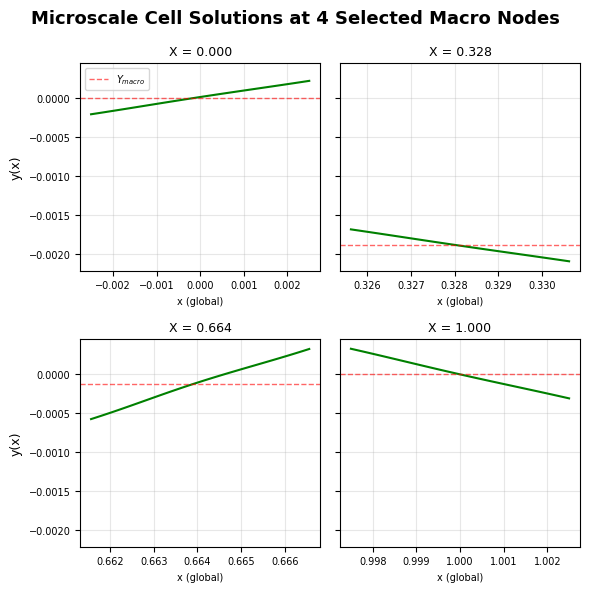
Error Summary
Comparison of HMM solution against the high-resolution deterministic reference.
In [27]:
coords_h, vals_hmm, vals_smooth, vals_corr, x_nodes, \
    Gamma_bar, f_bar, H_bar, micro_info_all, \
    Delta_Gamma, Delta_f, Gamma0_nodes, f0_nodes = hmm_data
coords_f, vals_f = fine_data

print("ERROR SUMMARY")

fine_on_macro = np.interp(coords_h, coords_f, vals_f)
l2_err_hmm = np.sqrt(np.mean((vals_hmm - fine_on_macro)**2))
linf_err_hmm = np.max(np.abs(vals_hmm - fine_on_macro))

print(f"  HMM vs fine-resolved FEM:")
print(f"    L2 error:   {l2_err_hmm:.6e}")
print(f"    Linf error: {linf_err_hmm:.6e}")
Plotting
In [29]:
from matplotlib.patches import Rectangle

coords_s, vals_s = smooth_data

# Extract micro min/max arrays
y_micro_min = np.array([m['y_min'] for m in micro_info_all])
y_micro_max = np.array([m['y_max'] for m in micro_info_all])
gamma_micro_min = np.array([m['gamma_min'] for m in micro_info_all])
gamma_micro_max = np.array([m['gamma_max'] for m in micro_info_all])
f_micro_min = np.array([m['f_min'] for m in micro_info_all])
f_micro_max = np.array([m['f_max'] for m in micro_info_all])
h_micro_min = np.array([m['h_min'] for m in micro_info_all])
h_micro_max = np.array([m['h_max'] for m in micro_info_all])

# --- Zoom region ---
ZOOM_LEFT = 0.77
ZOOM_RIGHT = 0.85

fig, axes = plt.subplots(5, 2, figsize=(14, 22))
fig.suptitle("1D Elliptic PDE — Correction Formulation: "
             r"$(\Gamma_0 + \Delta\Gamma)\,dY/dX$" "\n",
             fontsize=13, fontweight='bold', y=0.99)

# ================================================================
# Panel 1: Solutions comparison
# ================================================================
ax = axes[0, 0]
ax.plot(coords_s, vals_s, 'r--', linewidth=2,
        label=r'Smooth macro ($\Gamma_0$)', zorder=2)
ax.plot(coords_h, vals_hmm, 'g-o', linewidth=2, markersize=3,
        label='HMM', zorder=3)
ax.plot(coords_f, vals_f, 'b-', alpha=0.85, linewidth=1.5,
        label='Deterministic', zorder=1)
ax.set_xlabel('X')
ax.set_ylabel('Y(X)')
ax.set_title('Solution Comparison')
ax.legend(fontsize=9)
ax.grid(True, alpha=0.3)

# Draw zoom rectangle
zoom_mask_f = (coords_f >= ZOOM_LEFT) & (coords_f <= ZOOM_RIGHT)
zoom_mask_h = (coords_h >= ZOOM_LEFT) & (coords_h <= ZOOM_RIGHT)
zoom_mask_s = (coords_s >= ZOOM_LEFT) & (coords_s <= ZOOM_RIGHT)
y_vals_in_zoom = np.concatenate([
    vals_f[zoom_mask_f], vals_hmm[zoom_mask_h], vals_s[zoom_mask_s]
])
y_lo = y_vals_in_zoom.min()
y_hi = y_vals_in_zoom.max()
y_pad = (y_hi - y_lo) * 0.1
rect = Rectangle((ZOOM_LEFT, y_lo - y_pad), ZOOM_RIGHT - ZOOM_LEFT,
                  (y_hi - y_lo) + 2 * y_pad,
                  linewidth=1.5, edgecolor='orange', facecolor='orange',
                  alpha=0.12, zorder=4)
ax.add_patch(rect)

# ================================================================
# Panel 2: ZOOMED solution + micro min/max
# ================================================================
ax = axes[0, 1]
ax.fill_between(x_nodes, y_micro_min, y_micro_max, alpha=0.2, color='green',
                label='Micro min/max', zorder=0)
ax.plot(coords_s, vals_s, 'r--', linewidth=2.5,
        label=r'Smooth macro ($\Gamma_0$)', zorder=2)
ax.plot(coords_h, vals_hmm, 'g-o', linewidth=2.5, markersize=5,
        label='HMM', zorder=3)
ax.plot(coords_f, vals_f, 'b-', alpha=0.9, linewidth=1.8,
        label='Deterministic', zorder=1)
ax.set_xlim(ZOOM_LEFT, ZOOM_RIGHT)
ax.set_ylim(y_lo - y_pad, y_hi + y_pad)
ax.set_xlabel('X')
ax.set_ylabel('Y(X)')
ax.set_title(f'Solution Comparison (zoom: X in [{ZOOM_LEFT}, {ZOOM_RIGHT}])')
ax.legend(fontsize=8)
ax.grid(True, alpha=0.3)
ax.set_facecolor('#fffaf0')

# ================================================================
# Panel 3: Gamma comparison (Gamma_0 + Delta_Gamma vs full)
# ================================================================
ax = axes[1, 0]
x_fine = np.linspace(0, L, 5000)
H0_vals = H0_func(x_fine)
H_full_vals = H0_vals + H1_func(x_fine, LAMBDA, PHI)
Gamma_smooth_vals = Gamma_func(H0_vals)
Gamma_full_vals = Gamma_func(H_full_vals)

ax.plot(x_fine, Gamma_full_vals, 'b-', alpha=0.35, linewidth=0.4,
        label=r'$\Gamma$(H$_0$+H$_1$) ($\lambda$=' + f'{LAMBDA})')
ax.plot(x_fine, Gamma_smooth_vals, 'r--', linewidth=2,
        label=r'$\Gamma_0$(H$_0$) smooth')
ax.plot(x_nodes, Gamma_bar, 'go', markersize=6, zorder=5,
        label=r'$\Gamma_0 + \Delta\Gamma$ (HMM)')
ax.set_xlabel('X')
ax.set_ylabel(r"$\Gamma$")
ax.set_title(r'$\Gamma$ Comparison')
ax.legend(fontsize=9)
ax.grid(True, alpha=0.3)

coeff_zoom_mask = (x_fine >= ZOOM_LEFT) & (x_fine <= ZOOM_RIGHT)
c_lo = Gamma_full_vals[coeff_zoom_mask].min()
c_hi = Gamma_full_vals[coeff_zoom_mask].max()
c_pad = (c_hi - c_lo) * 0.1
rect2 = Rectangle((ZOOM_LEFT, c_lo - c_pad), ZOOM_RIGHT - ZOOM_LEFT,
                   (c_hi - c_lo) + 2 * c_pad,
                   linewidth=1.5, edgecolor='orange', facecolor='orange',
                   alpha=0.12, zorder=4)
ax.add_patch(rect2)

# ================================================================
# Panel 4: ZOOMED Gamma + micro min/max
# ================================================================
ax = axes[1, 1]
ax.fill_between(x_nodes, gamma_micro_min, gamma_micro_max, alpha=0.2, color='green',
                label='Micro min/max', zorder=0)
ax.plot(x_fine, Gamma_full_vals, 'b-', alpha=0.7, linewidth=0.8,
        label=r'$\Gamma$(H$_0$+H$_1$) ($\lambda$=' + f'{LAMBDA})')
ax.plot(x_fine, Gamma_smooth_vals, 'r--', linewidth=2,
        label=r'$\Gamma_0$(H$_0$) smooth')
ax.plot(x_nodes, Gamma_bar, 'go', markersize=8, zorder=5,
        label=r'$\Gamma_0 + \Delta\Gamma$ (HMM)')
ax.set_xlim(ZOOM_LEFT, ZOOM_RIGHT)
ax.set_ylim(c_lo - c_pad, c_hi + c_pad)
ax.set_xlabel('X')
ax.set_ylabel(r"$\Gamma$")
ax.set_title(r'$\Gamma$ Comparison (zoom: X in '
             f'[{ZOOM_LEFT}, {ZOOM_RIGHT}])')
ax.legend(fontsize=8)
ax.grid(True, alpha=0.3)
ax.set_facecolor('#fffaf0')

# ================================================================
# Panel 5: H comparison (H0 and H0+H1)
# ================================================================
ax = axes[2, 0]
ax.plot(x_fine, H_full_vals, 'b-', alpha=0.35, linewidth=0.4,
        label=r'H = H$_0$ + H$_1$ ($\lambda$=' + f'{LAMBDA})')
ax.plot(x_fine, H0_vals, 'r--', linewidth=2,
        label=r'H$_0$(X) smooth')
ax.plot(x_nodes, H_bar, 'go', markersize=6, zorder=5,
        label=r'$\bar{H}$ (HMM)')
ax.set_xlabel('X')
ax.set_ylabel('H')
ax.set_title('Field H')
ax.legend(fontsize=9)
ax.grid(True, alpha=0.3)

h_zoom_mask = (x_fine >= ZOOM_LEFT) & (x_fine <= ZOOM_RIGHT)
h_lo = H_full_vals[h_zoom_mask].min()
h_hi = H_full_vals[h_zoom_mask].max()
h_pad = (h_hi - h_lo) * 0.1
rect3 = Rectangle((ZOOM_LEFT, h_lo - h_pad), ZOOM_RIGHT - ZOOM_LEFT,
                   (h_hi - h_lo) + 2 * h_pad,
                   linewidth=1.5, edgecolor='orange', facecolor='orange',
                   alpha=0.12, zorder=4)
ax.add_patch(rect3)

# ================================================================
# Panel 6: ZOOMED H + micro min/max envelope
# ================================================================
ax = axes[2, 1]
ax.fill_between(x_nodes, h_micro_min, h_micro_max, alpha=0.2, color='green',
                label='Micro min/max', zorder=0)
ax.plot(x_fine, H_full_vals, 'b-', alpha=0.7, linewidth=0.8,
        label=r'H = H$_0$ + H$_1$ ($\lambda$=' + f'{LAMBDA})')
ax.plot(x_fine, H0_vals, 'r--', linewidth=2,
        label=r'H$_0$(X) smooth')
ax.plot(x_nodes, H_bar, 'go', markersize=8, zorder=5,
        label=r'$\bar{H}$ (HMM)')
ax.set_xlim(ZOOM_LEFT, ZOOM_RIGHT)
ax.set_ylim(h_lo - h_pad, h_hi + h_pad)
ax.set_xlabel('X')
ax.set_ylabel('H')
ax.set_title(f'Field H (zoom: X in [{ZOOM_LEFT}, {ZOOM_RIGHT}])')
ax.legend(fontsize=8)
ax.grid(True, alpha=0.3)
ax.set_facecolor('#fffaf0')

# ================================================================
# Panel 7: Delta_Gamma correction from micro
# ================================================================
ax = axes[3, 0]
ax.plot(x_nodes, Delta_Gamma, 'm-o', linewidth=2, markersize=4)
ax.axhline(y=0, color='k', linestyle=':', alpha=0.5)
ax.set_xlabel('X')
ax.set_ylabel(r"$\Delta\Gamma(X)$")
ax.set_title(r"Micro Correction $\Delta\Gamma = \bar{\Gamma} - \Gamma_0$")
ax.grid(True, alpha=0.3)

# ================================================================
# Panel 8: Delta_f correction from micro
# ================================================================
ax = axes[3, 1]
ax.plot(x_nodes, Delta_f, 'c-o', linewidth=2, markersize=4)
ax.axhline(y=0, color='k', linestyle=':', alpha=0.5)
ax.set_xlabel('X')
ax.set_ylabel(r"$\Delta f(X)$")
ax.set_title(r"Micro Correction $\Delta f = \bar{f} - f_0$")
ax.grid(True, alpha=0.3)

# ================================================================
# Panel 9: Additive solution correction
# ================================================================
ax = axes[4, 0]
ax.plot(coords_h, vals_corr, 'm-o', linewidth=2, markersize=4)
ax.axhline(y=0, color='k', linestyle=':', alpha=0.5)
ax.set_xlabel('X')
ax.set_ylabel(r'$\Delta$Y(X)')
ax.set_title(r'Solution Correction (Y$_{HMM}$ - Y$_{smooth}$)')
ax.grid(True, alpha=0.3)

# ================================================================
# Panel 10: Homogenised source term f from micro + micro min/max
# ================================================================
ax = axes[4, 1]
f_smooth_at_nodes = f_source_func(x_nodes)
ax.fill_between(x_nodes, f_micro_min, f_micro_max, alpha=0.2, color='cyan',
                label='Micro min/max', zorder=0)
ax.plot(x_nodes, f_bar, 'co-', linewidth=2, markersize=5,
        label=r'$f_0 + \Delta f$ (HMM)')
ax.plot(x_nodes, f_smooth_at_nodes, 'k--', linewidth=1.5,
        label=r'$f_0(X)$ macro')
ax.set_xlabel('X')
ax.set_ylabel(r"$f$")
ax.set_title(r"Source Term: $f_0$ vs $f_0 + \Delta f$")
ax.legend(fontsize=9)
ax.grid(True, alpha=0.3)

plt.tight_layout()
plt.show()